

ARTICLES, NEWSLETTERS AND MORE
Resources for Real Estate Investors
AI ROI in Real Estate: Why 56% of Firms Fall Short | ASPC Properties
Let's be honest — "AI is transforming real estate" has become one of those headlines you scroll past without reading. Everyone's saying it. Not everyone's proving it.
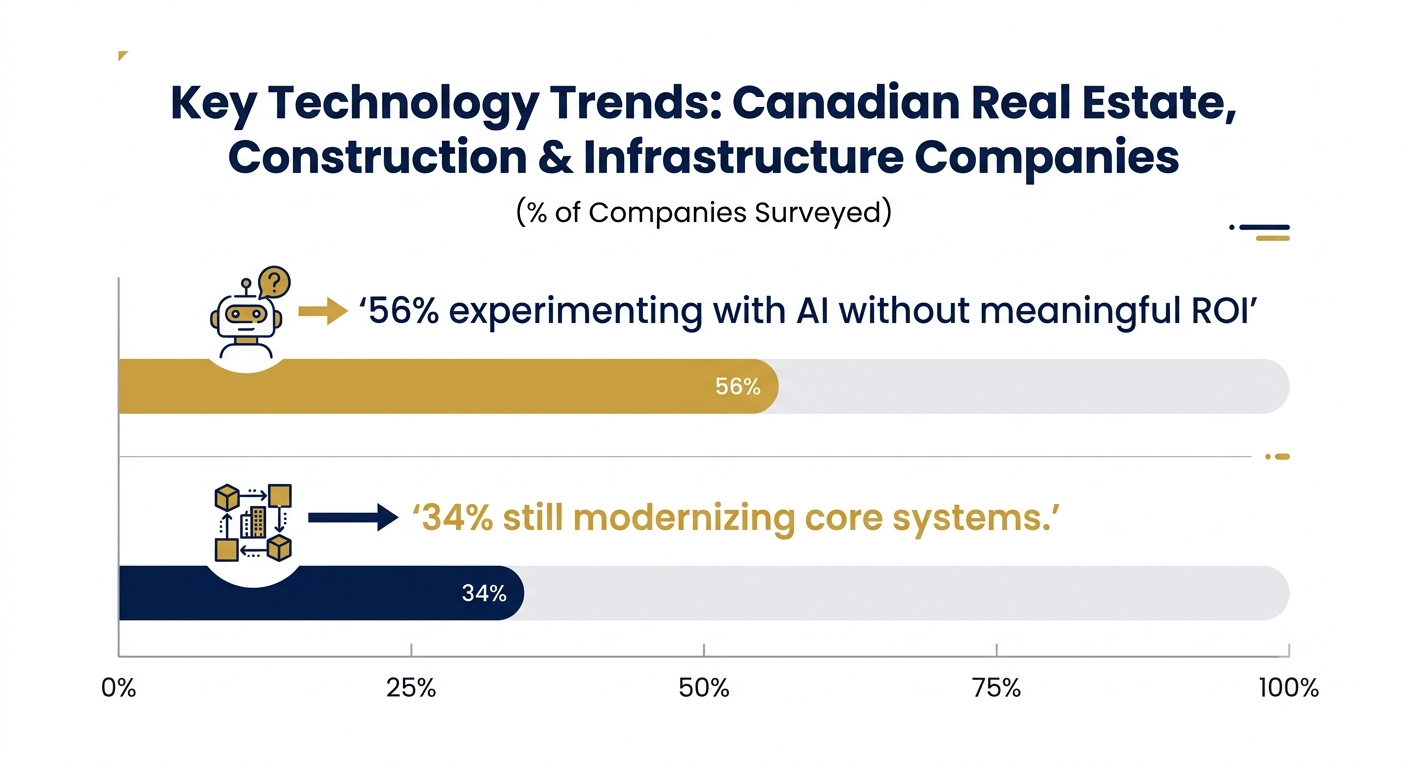
So when BDO Canada put out real numbers on this instead of vibes, I paid attention. Their 2026 industry survey found that 56% of Canadian real estate, construction, and infrastructure companies are experimenting with AI without seeing meaningful ROI yet. Another 34% are still working through the boring-but-essential step of modernizing their core systems before AI even enters the picture.
That's not a technology problem. That's an operating problem. And it's exactly the kind of gap I think about constantly as an operator — because the firms that close it are going to have a real edge over the ones still stuck running "pilots."
Key takeaways
More than half of real estate, construction, and infrastructure companies in Canada are experimenting with AI but not yet seeing real returns, per BDO's 2026 survey.
A third of firms haven't even finished modernizing the core systems AI depends on.
BDO's research says the gap isn't about weak technology — it's about treating AI as an IT project instead of a shift in how the business actually operates.
The firms seeing returns share four things: they tie AI to a measurable business outcome, they get their data and infrastructure in order first, they build governance in from day one, and they invest in their people, not just their software licenses.
Governance is becoming a competitive differentiator, not a compliance afterthought — and talent models are being rebuilt around it.
Why so many AI "initiatives" go nowhere

Here's the pattern BDO is seeing across hundreds of client engagements, and it matches what I've seen anecdotally in our own industry conversations: a firm buys a tool, runs a pilot in one department, gets a modest efficiency win, and then... nothing scales. The pilot stays a pilot.
BDO's read on why is pretty blunt. Organizations that stall are the ones still treating AI as a technology purchase rather than a change to how the business runs — its data, its infrastructure, its governance, and its people. You can have the best model on the market and still get zero return if the rest of the operation isn't built to use it.
The fix isn't more tools. It's sequencing. Fix the data foundation, build the governance rails, get the team fluent — then let AI do real work inside that structure.
The six shifts BDO says leaders need to plan for this budget cycle

BDO's AI Vision Report — built on a survey of more than 500 business leaders — flags six market signals they say leaders should be acting on now, not next year. The two most relevant to a business like ours: governance is turning into a genuine market credential (clients and partners are starting to ask about it directly), and talent models are being redesigned around AI-fluent teams rather than a single "AI department" off in the corner.
That second point tracks with something BDO said plainly in their coverage: AI fluency can't stay locked inside an IT team. If only your tech people understand the tools, the tools only ever reach as far as that one team's desk.
What Ahmad Ovais said that stuck with me
BDO's Ahmad Ovais, their AI Strategy & Transformation Leader, made a point I think applies directly to real estate operators, not just Big Six-style enterprises: firms that move from scattered pilots to real scale all "treat AI as an enterprise capability" — not a side experiment bolted onto one team's workflow. They build for speed without losing control of safety and adoption.
That's the whole ballgame, honestly. Speed without discipline gets you a flashy demo and no ROI. Discipline without speed gets you a task force that never ships anything. You need both.
Why this matters for a multifamily operator like us
I'll say the quiet part out loud: most real estate companies — including plenty of investors and operators — are exactly the audience BDO is describing. We sit on messy, decades-old property data spread across spreadsheets, PDFs, and whatever system a previous asset manager liked. Before any AI tool can meaningfully help with underwriting, maintenance forecasting, tenant communication, or reporting, that foundation has to be usable.
So the way I'm thinking about it for our own operation: don't chase the flashiest AI headline. Get the data foundation in shape first — clean, structured, connected across properties. Then pick one or two use cases tied to an actual business outcome, not "innovation for its own sake." Underwriting speed. Maintenance response time. Investor reporting accuracy. Something you can measure in dollars or hours, not something you can only measure in demos.
What I'd actually do with this

If I were advising a real estate or construction operator on their AI approach this quarter, here's the honest version: stop measuring success by how many tools you've piloted, and start measuring it by what outcome changed. Get your core systems and data cleaned up before you layer AI on top — that 34% still stuck on modernization isn't behind by accident, it's behind because that work is unglamorous and easy to defer. Put basic governance in place before you scale anything, not after something goes wrong. And spread AI literacy across the team instead of parking it with one person or one department.
None of that is exciting. All of it is what separates the 56% stuck in pilot purgatory from the smaller group actually seeing a return.
FAQ
Why aren't more real estate and construction companies seeing ROI from AI? According to BDO Canada's 2026 industry survey, 56% are experimenting without meaningful ROI and 34% are still modernizing core systems. BDO attributes the gap to treating AI as a technology project instead of an operating model shift.
What do the companies that ARE seeing AI returns have in common? BDO's research points to four habits: tying AI to measurable business outcomes, building a solid data and infrastructure foundation, embedding governance from the start, and investing in people's AI fluency rather than concentrating it in one team.
Is this just a real estate problem? No — BDO's broader AI Vision Report surveyed over 500 business leaders across industries and found similar patterns generally, but this specific 56%/34% figure is drawn from their real estate, construction, and infrastructure sector data.
What's the single biggest lever for scaling AI successfully? Governance. BDO's research frames it not as a brake on innovation but as what lets an organization move fast on AI without the initiative blowing up later.
Sources
BDO Canada — "56% of real estate leaders aren't seeing ROI from AI. Are you?" newsletter, July 8, 2026 (sector-specific survey data on real estate, construction & infrastructure)
BDO Canada — AI Vision Report: Past the Pilot to the Agentic Future of Work — bdo.ca/insights/the-agentic-future-of-work-ai-vision-report
BDO Canada — Real Estate & Construction industry page — bdo.ca/industries/real-estate-and-construction
BDO Canada — "BDO Explains: AI adoption—from gap to impact" (video with Ahmad Ovais) — youtube.com/watch?v=0R7R3eQb1oM

Sign up for our mailing list for exclusive updates.
Enroll to receive our newsletter with exclusive opportunities and updates.
We will not, in any circumstances, share your personal information with other individuals, public organizations, or corporations. We do not sell, communicate, or disclose your information to any mailing lists. By providing your information, you are consenting to receive occasional communication, such as newsletters, from ASPC.
© 2025 ASPC Properties. All Rights Reserved
Disclaimer: The information provided on this website is for general informational purposes only and should not be considered as financial, legal, or investment advice. ASPC Properties does not make any representations or warranties, express or implied, regarding the accuracy, completeness, or suitability of the information on this site. Real estate investments inherently involve risks, and past performance is not indicative of future results. Investors should conduct their own due diligence and seek professional advice before making any investment decisions. ASPC Properties is not liable for any loss or damage arising from reliance on the information provided on this website.
We will not, in any circumstances, share your personal information with other individuals, public organizations, or corporations. We do not sell, communicate, or disclose your information to any mailing lists. By providing your information, you are consenting to receive occasional communication, such as newsletters, from ASPC.