Ontario Multifamily Investing in 2026: What We're Watching
Let's be honest — most "2026 market outlook" posts are noise. Big numbers, vague takeaways, and a conclusion you could've guessed without reading any of it.
I'd rather give you the version I'd actually want if I were the one writing the cheque.
So here's where Ontario multifamily investing stands halfway through 2026 — the rates, the rents, the cap rates, and the handful of things I'm personally watching before we move on a building. No fluff…
Key takeaways
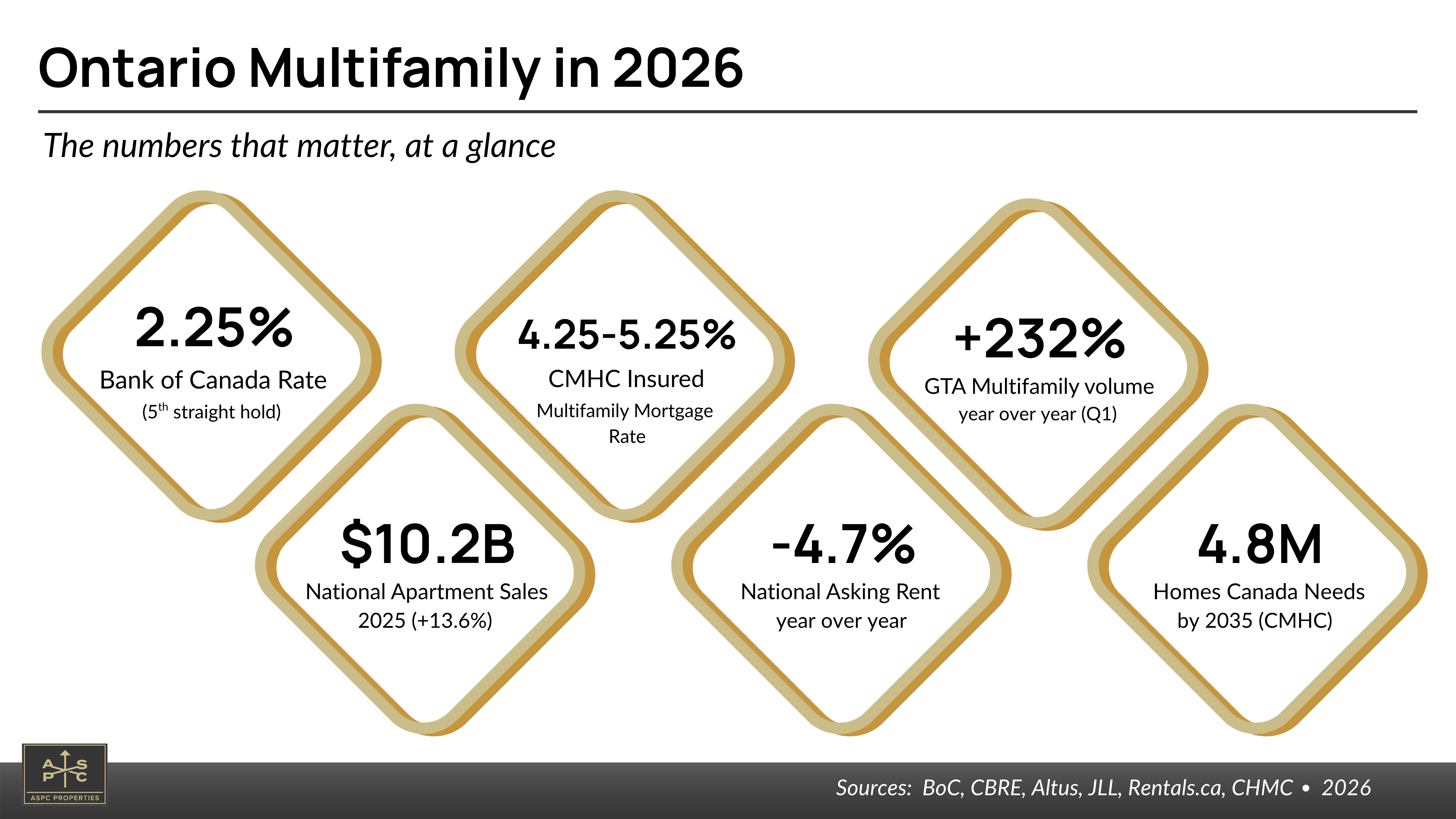
The Bank of Canada has held its rate at 2.25% five times in a row. Stable financing, not falling financing.
Rents are softening — national asking rents are down for 20 straight months — but apartment buildings are trading again, hard. GTA multifamily volume jumped 232% year-over-year in Q1.
Ontario cap rates ticked up slightly while almost every other property type compressed. That's a window, not a warning.
Two tax changes can knock the full 13% HST off new rental construction in Ontario.
The big REITs are being taken private at 30%+ premiums. When that much smart money sees value, I pay attention.
What the Bank of Canada's rate hold means for apartment deals
Start with the number that drives everything else: on June 10, 2026, the Bank of Canada held its overnight rate at 2.25% — the fifth hold in a row. The next decision lands July 15.
Here's the honest read. The Bank isn't signalling cuts. It's watching two things pull in opposite directions — trade tension on one side, energy prices on the other — and sitting still until one of them wins. Most of the big banks now expect rates to stay put through the rest of the year.
For us, that's actually fine. Stable beats falling-but-uncertain when you're underwriting a five-year hold.
What you should care about is the financing, not the headline rate. CMHC-insured multifamily money is running roughly 4.25% to 5.25% right now. That's livable. And paired with the right CMHC program, it's the single biggest lever on your returns — more on that below.
Ontario multifamily cap rates in 2026: where they actually sit
This is the line that surprised a lot of people. In the first quarter, multifamily was the one major property type where cap rates went up, while office and industrial compressed.
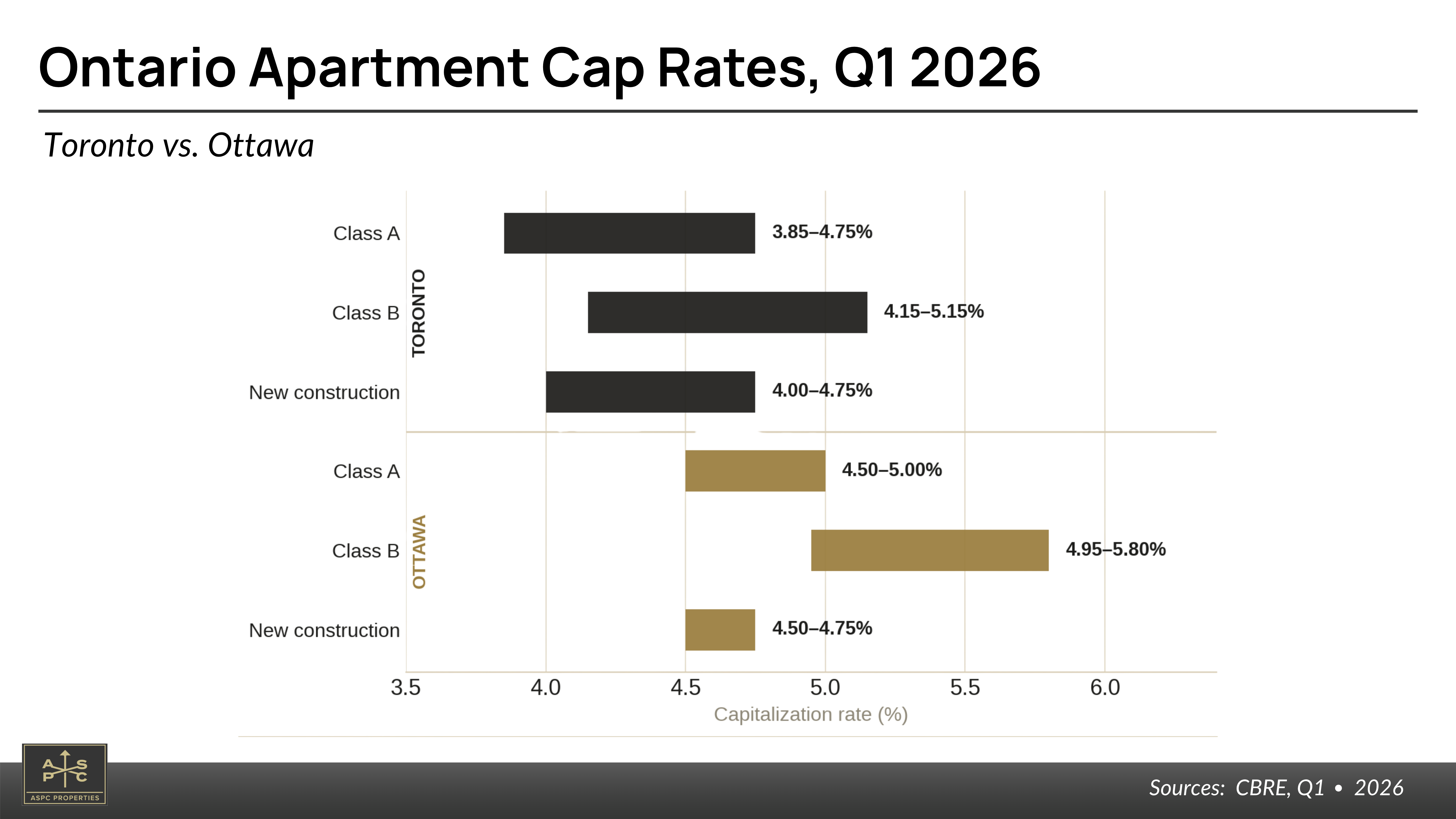
Sounds bad. It isn't. It means pricing got a touch more reasonable in the exact asset class with the strongest long-term story.
Where things stand in our markets (CBRE, Q1 2026):
Toronto — a well-kept Class A building trades around 3.85% to 4.75%.
Ottawa, our own backyard — closer to 4.50% to 5.00%.
Both are still among the tightest apartment markets in the country. CBRE's Ottawa team flat-out called the city's residential market "a key differentiator" versus the rest of Canada. I'd agree — and we're not exactly neutral on that one.
Why apartment buildings are suddenly trading again
For four years, multifamily sales slid. That reversed.
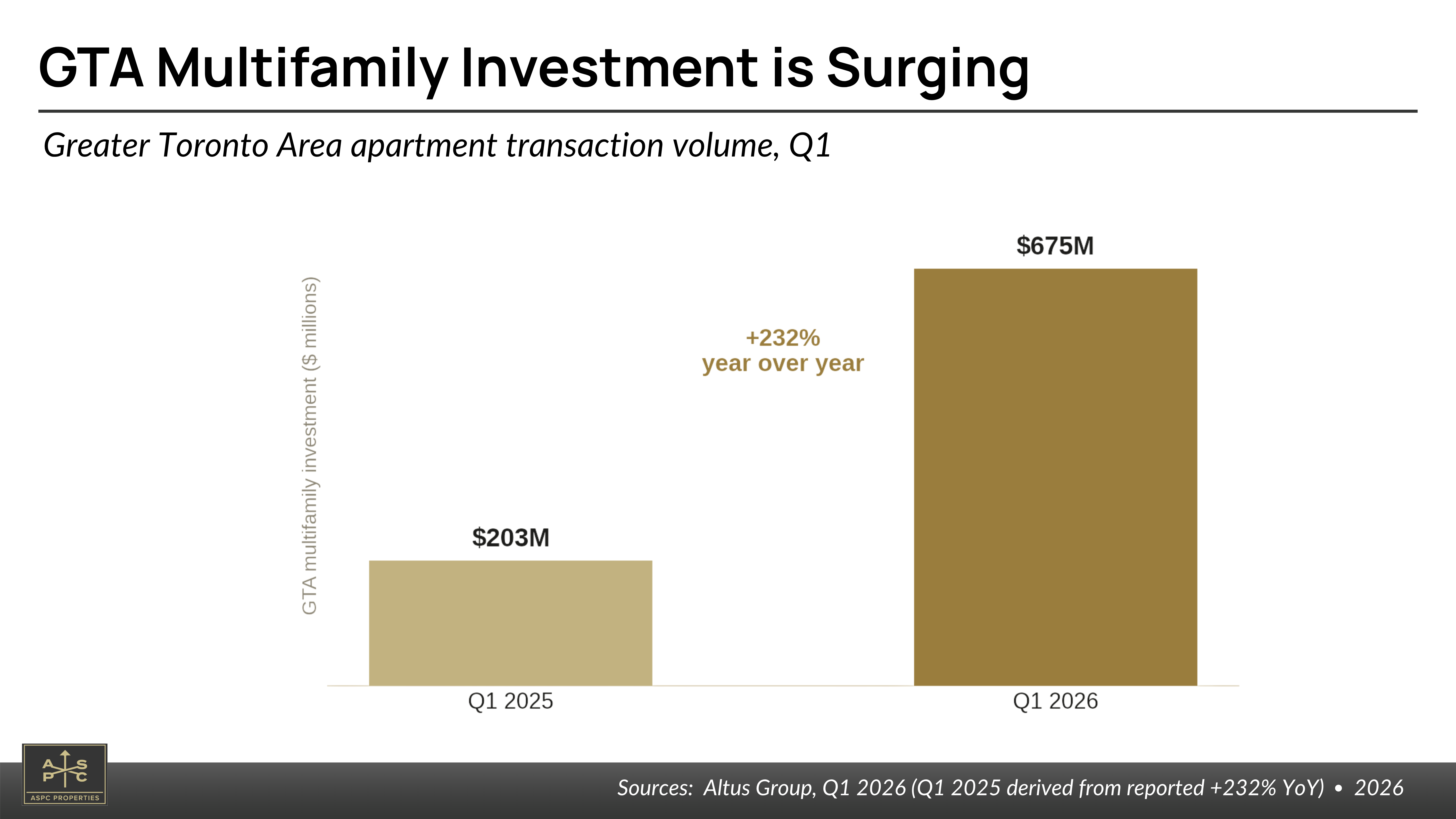
In 2025, national apartment investment sales hit $10.2 billion — up 13.6% — the first increase in four years. Then Q1 2026 came in even hotter: multifamily was the most active commercial property type in the country, and GTA multifamily volume rose 232% year-over-year to nearly $675 million.
And it's not just institutions. Private buyers took more than half of the acquisitions. That tells me the people who actually run buildings — not just allocate capital — are stepping back in. That's usually a good sign about where we are in the cycle.
Rents are falling. Here's why I'm not worried.
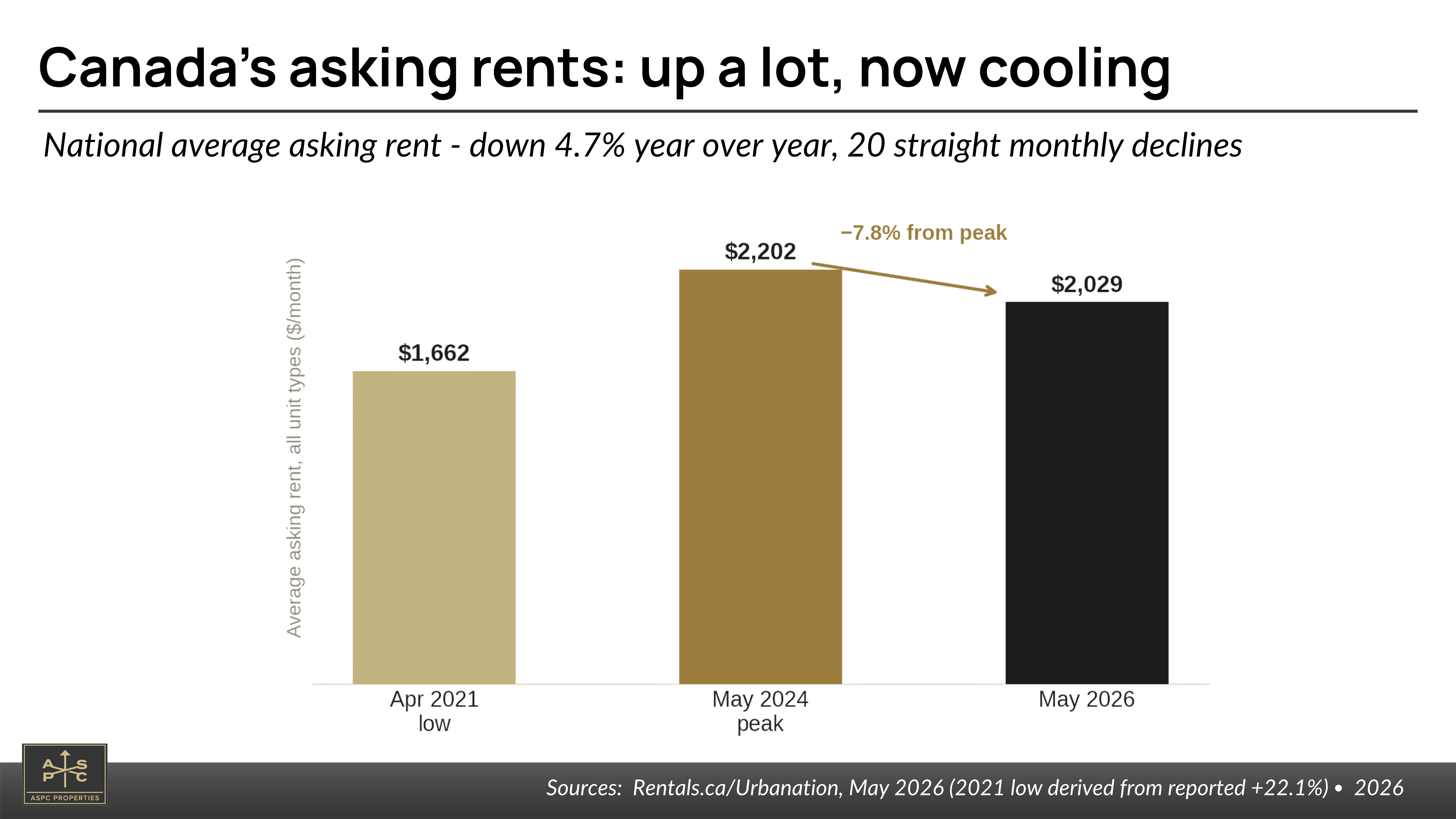
I'm not going to pretend the rent chart looks pretty. National asking rents hit $2,029 in May 2026, down 4.7% from a year ago — the 20th straight monthly decline. Ontario one-bedrooms are off somewhere in the 5–7% range depending on the city.
So why am I still buying the long-term story?
Three reasons.
First, those are asking rents — what landlords post on new vacancies. What your existing tenants actually pay is still climbing in a lot of Ontario markets. The headline overstates the pain.
Second, the supply that caused this is about to thin out. Record numbers of units finished at once, which softened rents — but new starts are now falling. Fewer completions ahead, just as demand recovers, is exactly the setup that re-tightens a market.
Third, the long game hasn't changed. CMHC still estimates Canada needs up to 4.8 million new homes by 2035 to fix affordability. We are not building anywhere close to that. You don't solve a structural shortage in eighteen soft months.
I'd rather buy into a temporary dip in a market with that backdrop than chase a hot one.
CMHC MLI Select is still the engine — but the window is closing
If you invest in Canadian apartments and you're not using MLI Select, we should talk.
In plain terms, it's a CMHC program that — when a building hits the top scoring tier — can get you up to 95% loan-to-cost and a 50-year amortization. That combination does more for your returns than almost anything else you can negotiate.
Here's the catch, and why I'm flagging it now: the energy-efficiency rules that determine whether you hit that top tier get tougher after September 30, 2026. CMHC also moved to risk-based pricing, which adds a small premium for every stretch of amortization beyond 25 years.
Translation: if you've got a new-construction or major-repositioning project, the math is friendlier before that deadline than after. Worth moving on.
The immigration question everyone's asking
I'll address it head-on, because every investor I talk to raises it.
Yes — population growth has stalled. Canada's population actually fell by about 55,000 in the first quarter of 2026, driven by fewer temporary residents, and permanent-resident targets are frozen at 380,000 a year through 2028. Less population growth means less rental demand. That's the real near-term risk, and I won't wave it away.
But two things keep me steady. Renters are still forming new households — younger renters especially — even with the slowdown. And policy can turn. If growth stays weak, there's already pressure building to ease those targets back up.
I underwrite for the soft case and let the recovery be upside. I don't pay today for a rebound I'm only hoping for.
Two tax changes that quietly improve the math
This is the part that doesn't make headlines but absolutely moves a pro forma.
The federal government now offers a 100% rebate of the GST on new purpose-built rental construction. And in its March 2026 budget, Ontario proposed scrapping its 8% provincial portion of HST on new rental housing too.
Stack those, and you can potentially erase the entire 13% HST on a new Ontario rental build. On a multi-unit project, that's not a rounding error — that's the difference between a deal that pencils and one that doesn't.
(The Ontario piece was still proposed, not final, as I'm writing this — so confirm the details before you bank on it.)
When the big REITs go private, pay attention
Here's the signal I keep coming back to.
In the last year, two of Canada's well-known apartment REITs agreed to be taken private — InterRent at about a 35% premium, and Minto at roughly 32%. Big, sophisticated capital paid up — over public market price — to own Canadian apartments.
One RBC analyst put it simply: there's a real disconnect between what the public market and the private market think these buildings are worth. The private market is voting with billions.
Even the head of the country's largest public landlord noted who's buying the buildings they're selling: young, private operators using MLI Select to acquire. That's the lane. That's exactly where we play.
So what would I actually do right now?
If you handed me capital this quarter, here's the honest playbook.
Treat 2026 as a buyer's window — but stay selective. Softer rents plus a 232% jump in transactions plus REITs going private all point the same way. I'd target stabilized Class B buildings in supply-constrained, job-anchored markets — Ottawa's government and tech base, established GTA neighbourhoods — not shiny new product competing with condo-investor supply.
Underwrite to flat rents, not the old 8–10% growth. Build in lease-up time. Stress-test your renewal against five-year money around 4.5–5.25%. Let the re-tightening be your upside, not your assumption.
Use MLI Select before the September 30 change on anything new-build or heavy-repositioning. The leverage and amortization are the whole game.
Stack the HST rebates on any new-rental project. Confirm eligibility, then let it swing the pro forma.
Watch three triggers: the July 15 Bank of Canada decision and bond yields, any reversal on immigration targets, and whether Ontario housing starts keep falling. Any one of those moving changes the playbook.
Let's talk
This is what I love about this part of the cycle — the noise scares off the tourists, and the people who actually understand the asset get a cleaner shot at good buildings.
At ASPC, we partner with high-net-worth investors, funds, and family offices to acquire, improve, and manage quality apartment buildings across Ontario. Clean numbers, straight answers, and deals we'd put our own money into — because we do.
If you're actively investing and want fewer, better-qualified multifamily opportunities crossing your desk, let's chat. I'll show you exactly how we evaluate a building before it ever reaches you.
FAQ
Is now a good time to invest in Ontario apartment buildings? Mid-2026 looks like a selective buyer's window. Rents are soft and cap rates have ticked up slightly, but transaction volumes are surging and major REITs are being taken private at premiums — signs that sophisticated capital sees value at current pricing. The key is buying the right building in a supply-constrained, employment-anchored market and underwriting to flat near-term rents.
What are cap rates for Ontario multifamily in 2026? As of Q1 2026, a Class A apartment building runs roughly 3.85%–4.75% in Toronto and about 4.50%–5.00% in Ottawa, per CBRE. Multifamily was the one major commercial property type where cap rates edged up rather than compressed.
What is CMHC MLI Select? It's a CMHC insurance program for multi-unit residential properties that rewards energy efficiency, affordability, and accessibility with better financing — at the top tier, up to 95% loan-to-cost and amortizations as long as 50 years. The scoring rules tighten after September 30, 2026.
Will falling rents hurt apartment investors? Asking rents have fallen for 20 straight months, but that reflects a temporary wave of new supply, and existing-tenant rents are still rising in many Ontario markets. With new construction starts now falling and a structural housing shortage in place, most analysts expect the rental market to re-tighten over the next couple of years.
How do Bank of Canada rates affect multifamily deals? They set the backdrop for financing costs. The Bank held its rate at 2.25% in June 2026, and CMHC-insured multifamily mortgages are currently around 4.25%–5.25%. A stable rate environment makes long-hold underwriting more predictable, which is exactly what apartment investors want.
This post is for information only — it's how ASPC see the market, not personalized investment advice. Every deal deserves its own diligence, and the figures here reflect data available as of June 2026.
Sources
Interest rates & macro
Bank of Canada — Interest Rate Announcement, June 10, 2026 (rate held at 2.25%) · bankofcanada.ca
BMO Capital Markets — Canadian rate outlook commentary, June 2026
Statistics Canada — Labour Force Survey (May 2026), GDP (Q1 2026)
Financing & cap rates
CBRE — "Canadian Cap Rates & Investment Insights, Q1 2026" (April 21, 2026) · cbre.ca
LendCity Mortgages — "Commercial Mortgage Rates Canada 2026" · lendcity.ca/blog/commercial-mortgage-rates-canada/
Altus Group — GTA / Canadian CRE quarterly investment data · altusgroup.com/research/cre-this-week-in-canada/
JLL — Canada multifamily investment review (2025 full-year sales)
Rents & vacancy
Rentals.ca / Urbanation — National Rent Report, June 2026 (May 2026 data) · rentals.ca
CMHC — Rental Market Report 2025 & 2026 Mid-Year Update · cmhc-schl.gc.ca
CMHC programs & housing supply
CMHC — MLI Select program updates (risk-based pricing eff. July 14, 2025; energy-code change eff. Nov 28, 2025, grace window to Sept 30, 2026)
CMHC — Housing supply gap update, June 2025 (up to 4.8M homes needed by 2035)
Immigration & population
Statistics Canada — Quarterly population estimates, Q1 2026
Immigration, Refugees and Citizenship Canada — 2026–2028 Immigration Levels Plan
Policy & tax
Department of Finance Canada — Purpose-Built Rental Housing 100% GST rebate; Bill C-4 (Royal Assent March 12, 2026)
Government of Ontario — 2026 Budget (tabled March 26, 2026), proposed 8% HST rebate on new rental housing; 2026 Rent Increase Guideline (2.1%)
REIT / M&A activity
InterRent REIT, Minto Apartment REIT, Dream Residential REIT, CAPREIT — take-private announcements (2025–2026)
RBC Capital Markets — REIT analyst commentary; coverage via Renx, Financial Post, The Globe and Mail